
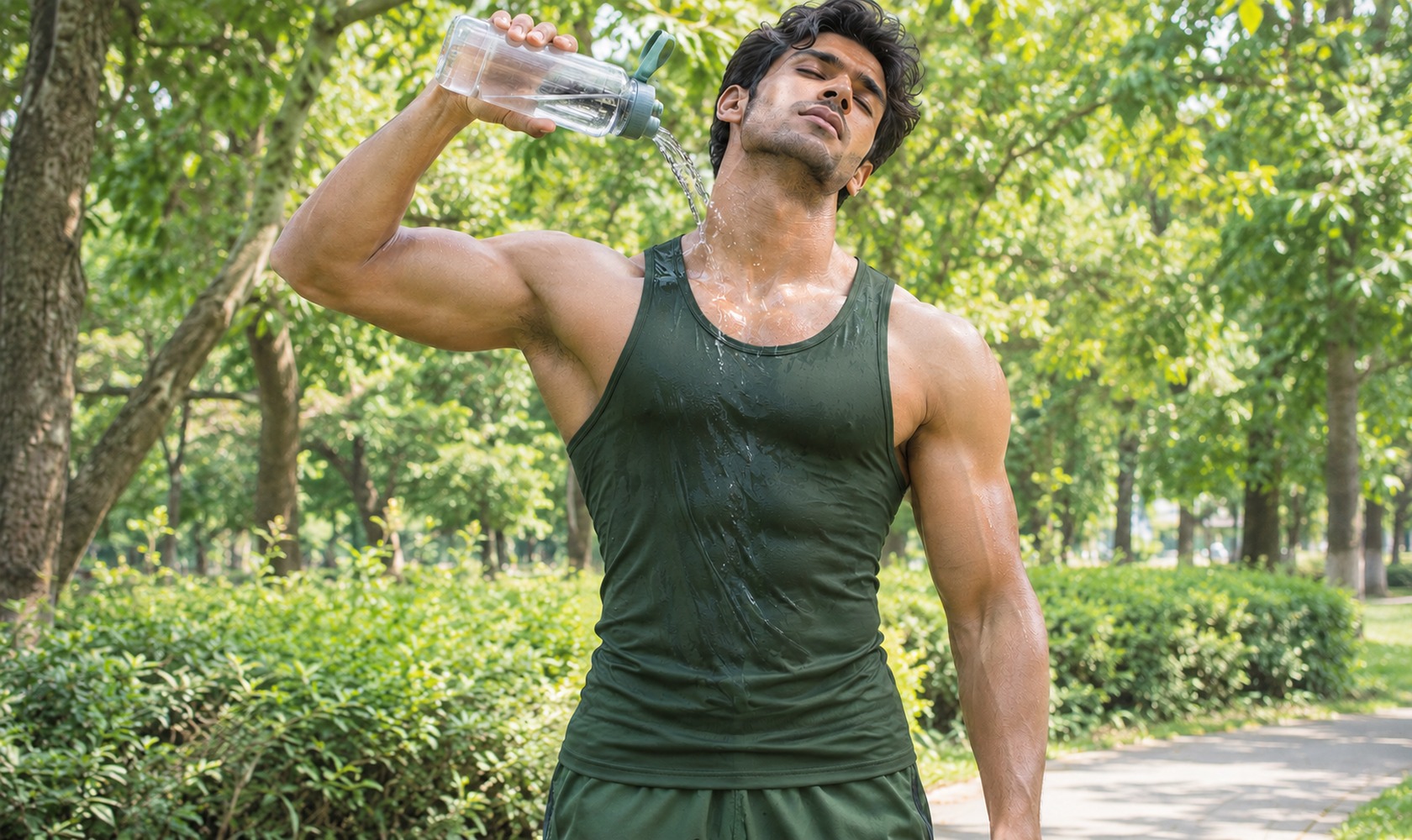


Exercise produces heat as well as movement
Muscles convert chemical energy into mechanical work, but much of the energy involved appears as heat. The harder and longer the effort, the more heat must be managed. The surrounding environment affects how readily that heat can leave the body. Air temperature, humidity, direct sun, clothing and air movement all influence the challenge, so two identical workloads can impose very different thermal demands.
Sweating is one part of the response, not the entire cooling system. Blood flow to the skin helps move heat from the body core toward the surface. Evaporation can then remove heat, while other forms of transfer depend on the temperature difference between the body and environment. A person can therefore be sweating heavily without cooling effectively if conditions limit evaporation.
This explains why a dry, breezy setting and a humid indoor room can feel different at the same thermometer reading. The amount of visible sweat is not a complete description of heat loss. It is the interaction of production and dissipation that matters, including whether clothing traps moisture and whether the athlete can reduce exposure when the conditions change.
Evaporation and dripping sweat are not equivalent
Sweat that evaporates from the skin can remove heat. Sweat that drips to the floor contributes to fluid loss without providing the same evaporative benefit at the skin. High humidity makes evaporation more difficult because the surrounding air already contains substantial moisture. A fan or breeze can change the local conditions by moving air across the surface.
The distinction is important when interpreting dramatic sweating during a cut. More visible sweat does not demonstrate more calories burned, more fat oxidized or a superior response to a product. It may simply indicate heat stress or a less effective environment for cooling. Increasing effort to reproduce that appearance is therefore a poor way to define a productive session.
Clothing also changes the system. Extra layers may increase thermal discomfort and sweat accumulation while leaving the actual exercise output unchanged. A larger drop in body weight afterward mainly demonstrates that more mass left during the session, often as fluid. It does not provide a shortcut for measuring a change in stored fat.
Fluid loss and blood volume
Sweating removes water and electrolytes. If fluid loss becomes substantial, the cardiovascular system has to manage exercise and cooling under altered conditions. The relationship between pulse and pace can change as the session progresses. An athlete may see a rising heart rate despite holding the same speed or power, especially when heat and fatigue accumulate.
This phenomenon should not automatically be interpreted as moving into a more effective fat-burning zone. The same external work can become more physiologically demanding. A training device may record the higher pulse accurately while estimating calorie expenditure with considerable uncertainty. The measurement of heart rate is more direct than the interpretation attached to it.
Research and professional guidance on exercise hydration emphasize individual variation in sweat rate and sweat electrolyte content. 1 That variation is a reason to avoid one universal fluid rule for all athletes and all conditions. Body size, environmental exposure, exercise duration and opportunities to drink can differ substantially between a short gym session and a prolonged outdoor event.
Why a quick weight change is mostly a fluid question
A before-and-after body-weight comparison can help describe net mass change during a session if conditions are reasonably standardized. Food, drinks, bathroom use and wet clothing affect the result. Even with careful measurement, the comparison does not chemically identify every component of the change. It is most useful as context for fluid balance rather than as an estimate of fat removed.
A person who finishes lighter after sweating and then returns toward the earlier weight after drinking has not necessarily regained fat. The timescale and the source of the change matter. Replacing fluid is different from storing a substantial new amount of body fat. Confusing the two can encourage unnecessary restriction after an otherwise ordinary rehydration response.
The same mistake appears in photographs. A temporary change in skin appearance after a hot workout may be assigned to fat loss even when the underlying tissue could not have changed to that extent in a few hours. Visual definition, fluid balance and tissue mass should remain separate observations.
When drinking more is not automatically better
Avoiding dehydration does not mean that unlimited fluid intake is harmless. During prolonged activity, excessive drinking relative to losses can create another problem, including dilution of blood sodium in some circumstances. This is one reason a rigid instruction to drink as much as possible is unsuitable. The balance concerns both the amount lost and the amount consumed.
Electrolyte products also vary. A beverage containing sodium is different from taking a potassium tablet, and a product labeled hydration does not establish what an individual needs. Ingredient amounts, normal meals, kidney function and other medicines can all be relevant. A cramp or headache cannot identify the correct supplement by itself.
For short ordinary exercise, normal food and fluid routines may be enough, while longer or hotter exposures require more specific planning. The important point is that the situation determines the need. A bodybuilder using a stimulating product should not assume that an electrolyte drink neutralizes unrelated cardiovascular or metabolic effects.
| Observation | What it can reflect | What it does not measure |
|---|---|---|
| Heavy sweating | Heat production, environment and individual sweat response | The amount of body fat lost |
| Rising pulse at steady pace | Increasing physiological strain or other influences | A guaranteed increase in useful training work |
| Lower weight immediately afterward | Net fluid and other mass changes during the session | A lasting reduction in fat tissue |
| Rapid weight return after drinking | Restoration of fluid | Automatic fat regain |
| Cramp during a hot session | Several possible muscular or systemic causes | A specific electrolyte concentration |
The role of stimulation in a hot workout
Clenbuterol can produce symptoms such as tremor, palpitations and a feeling of stimulation. Heat and exercise can create overlapping sensations. When they occur together, it may be difficult to judge whether a change is ordinary exertion, thermal strain or an adverse reaction. That uncertainty should not be resolved by assuming that every symptom is part of an effective cut.
Caffeine is another exposure frequently added before exercise, but evidence about caffeine and hydration cannot be used to establish the safety of combining it with clenbuterol. Each substance has its own actions and the combined setting may not have been tested. General exercise research is useful background, not permission to treat one product as protection against another.
A practical assessment keeps the ingredients and circumstances visible. What was used, when was it taken, what was the temperature and what work was performed? A clear description helps distinguish a changed environment from a changed product or workload. It also provides useful information if symptoms require medical attention.
Heat illness changes the priority
Confusion, collapse, marked loss of coordination or severe symptoms during heat exposure are not simply signs of a demanding workout. They require an urgent response. A person who becomes unwell should not be encouraged to finish a set or continue cardio to preserve a calorie target. The immediate issue is the person's condition and access to appropriate help.
Symptoms can overlap with other emergencies, including drug toxicity. A rapid pulse alone cannot determine the cause. Keep the exposure history available and describe the actual symptoms rather than assigning a diagnosis from a fitness discussion. If someone has chest pain, faints or develops severe breathing difficulty, emergency assessment takes priority over training calculations.
A person can also become unwell without looking completely exhausted. Clothing, lighting and a brief conversation do not reliably establish internal temperature or blood chemistry. Judging severity from appearance alone can be misleading, particularly when the person is motivated to minimize symptoms and continue preparation.
Comparing indoor and outdoor sessions
An indoor gym can reduce direct sun exposure yet still present a significant heat burden if ventilation is poor. A crowded room, low air movement and equipment that traps body heat can change the experience. Outdoors, shade, wind and the surface beneath the athlete all influence conditions. Temperature alone does not fully capture either setting.
This matters when a familiar session suddenly feels much harder. If the room is warmer, the pulse response may differ even when the athlete's fitness has not changed. If the outdoor route is exposed to sun rather than shaded, the comparison is also different. Recording the environment prevents a thermal explanation from being overlooked in favor of a more dramatic theory about a drug or metabolism.
The workload itself should remain explicit. A longer incline walk, an additional interval block or shorter rest breaks can all raise heat production. If several changes occur together, the result cannot identify one cause. A more careful comparison focuses on matched conditions before interpreting the apparent response.
A useful way to review a difficult hot session
Start with the sequence of events. Identify the environmental change, the planned work, when symptoms began and whether they continued after stopping. Note the fluids consumed and any products taken, without guessing that their labels accurately explain the reaction. This creates a more coherent account than a single statement that the athlete sweated unusually heavily.
Next, separate performance from body-weight change. Was less work completed, was the same work more uncomfortable, or did the athlete simply finish lighter? Those are different outcomes. A temporary lower scale reading should not turn an otherwise poorly tolerated session into an apparent success. The ability to cool, recover and function afterward is part of the training outcome.
The goal of exercise in heat is not to maximize sweat for its own sake. It is to complete an appropriate task while managing the environmental demands. Treating sweat, fluid change and fat loss as separate processes removes much of the confusion that surrounds hot workouts during cutting. It also makes it easier to recognize when a session has become a health problem rather than a useful training stimulus.
Acclimatization does not make every exposure equivalent
Repeated experience in hot conditions can change how an athlete responds, but familiarity should not be mistaken for unlimited protection. A person accustomed to one climate can still face a different challenge when humidity, direct sun, clothing or workload changes. Heat adaptation and the current environmental burden are separate parts of the situation.
The first unusually hot session of a season can therefore differ from a familiar cool-weather routine. So can returning after illness or a period away from training. Comparing performance without acknowledging that transition can make the athlete appear suddenly less fit, even though the environment changed more than the underlying training capacity.
Professional guidance on exertional heat illness emphasizes recognition, preparedness and an appropriate response when an athlete becomes unwell. 2 An important practical implication is that someone nearby should not have to invent a plan after confusion or collapse occurs. The location, access to help and the ability to stop activity matter alongside the exercise prescription.
Fluid planning also needs to distinguish a short session from a prolonged event. Opportunities to drink, environmental exposure and the ability to leave the setting can differ greatly. A strategy copied from an endurance event may not describe an ordinary gym workout, while a casual approach suitable for a brief session may be inadequate for a much longer exposure.
Consensus work on exercise-associated hyponatremia addresses the opposite side of simplistic hydration advice: excessive fluid intake can also create a dangerous situation. 3 The broader lesson is balance rather than maximizing one input. More sweating, more drinking and more supplementation are not three automatic signs of better heat management. The relevant outcome is appropriate physiological function under the actual conditions.
Wet clothing can distort a weigh-in
Clothing that retains sweat adds mass to the post-exercise measurement. A comparison made in dry clothing before exercise and wet clothing afterward therefore contains an avoidable difference. The result may understate the mass that left the body during the session.
That does not mean the corrected difference is fat loss. It simply improves the description of a fluid-related observation. Consistency of clothing and measurement conditions makes the number more interpretable, while food and drinks consumed during the session still need consideration. The distinction between measuring mass accurately and identifying its biological source remains essential even in a carefully performed comparison.
Sources
- Sawka et al. (2007). American College of Sports Medicine position stand. Exercise and fluid replacement. Med Sci Sports Exerc.
- Casa et al. (2015). National Athletic Trainers' Association Position Statement: Exertional Heat Illnesses. J Athl Train.
- Hew-Butler et al. (2015). Statement of the Third International Exercise-Associated Hyponatremia Consensus Development Conference, Carlsbad, California, 2015. Clin J Sport Med.